
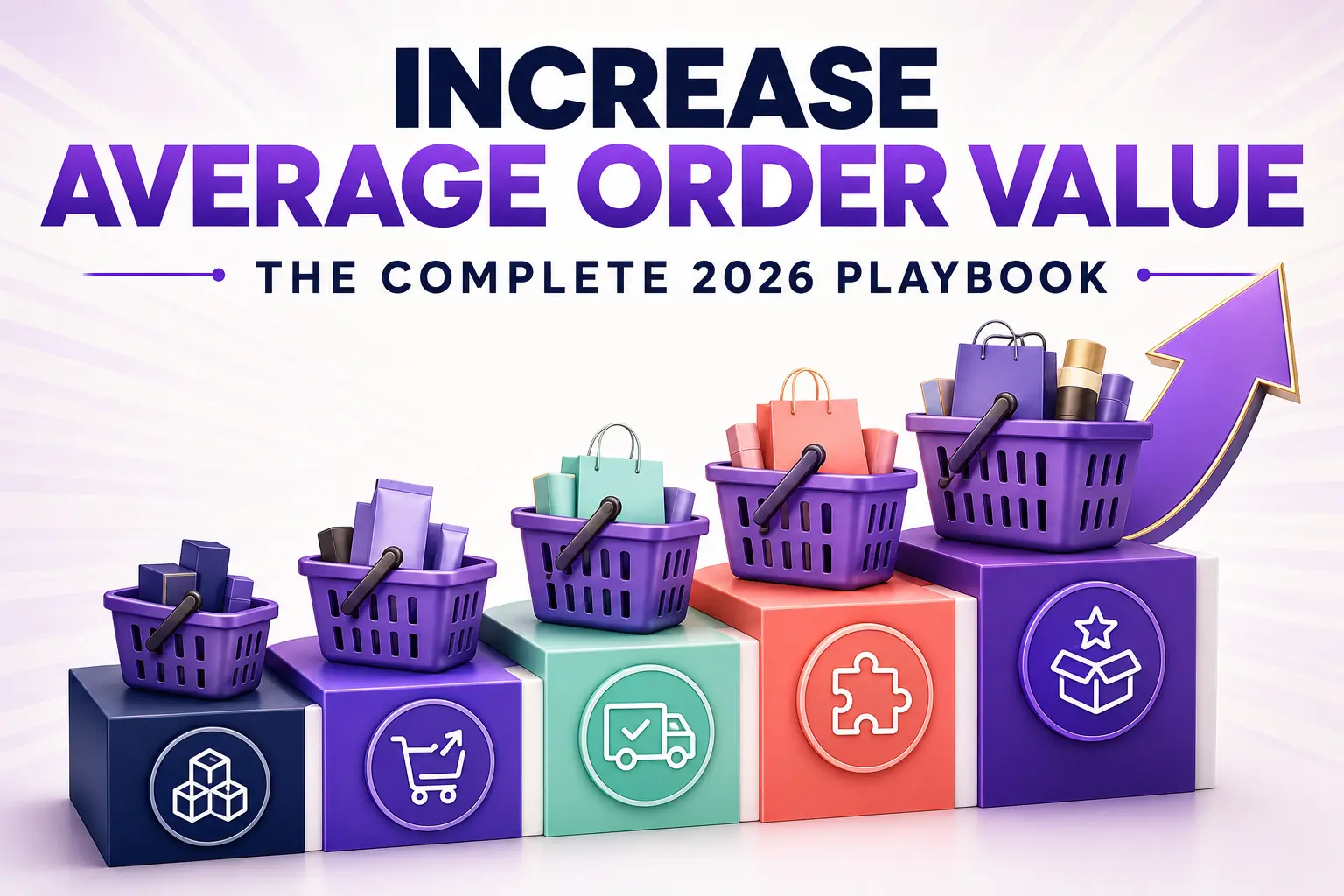
How to Increase Average Order Value on Shopify: The Complete 2026 AOV Playbook
The 2026 Shopify AOV playbook covering every lever that lifts average order value, from bundles and upsells to checkout extensions, with a prioritized plan.
In this article
- 01 What is average order value on Shopify?#
- 02 Lever 1: Bundles#
- 03 Lever 2: In-cart upsells#
- 04 Lever 3: Cross-sells#
- 05 Lever 4: Free gifts#
- 06 Lever 5: Free shipping progress bars#
- 07 Lever 6: Shipping protection#
- 08 Lever 7: Checkout extensions#
- 09 Lever 8: Post-purchase offers#
- 10 Sequencing: which levers to build first#
- 11 How to measure AOV correctly on Shopify#
- 12 The compound effect of the full AOV stack#
- 13 Frequently Asked Questions#
Every Shopify growth conversation eventually lands on the same question: what is the highest-leverage thing we can do to grow revenue without spending more on acquisition?
In 2026, the answer is average order value. Traffic is expensive, and the cost keeps rising. Conversion rate optimization is slow, requiring sustained testing infrastructure and months to see meaningful results. AOV is different. Lift it 15 percent and every existing customer, every existing campaign, and every existing channel produces 15 percent more revenue with no additional acquisition spend.
This playbook covers every lever that meaningfully moves AOV on Shopify, organized by where in the customer journey it applies. Not every store needs every lever. The right combination depends on your catalog, your average price point, and where you are in your growth stage. But every Shopify merchant should understand the full toolkit so they can prioritize intelligently rather than guessing.
What is average order value on Shopify?
Average order value (AOV) is the average amount a customer spends in a single transaction on your Shopify store. The formula is straightforward: total revenue divided by total number of orders over the same period.
AOV sits inside a broader revenue equation alongside traffic and conversion rate: Revenue equals Traffic multiplied by Conversion Rate multiplied by AOV. Lifting any one of those three variables grows revenue. The reason AOV has become the focus in 2026 is that traffic is expensive to grow and conversion rate is slow to move. AOV improvements can be implemented this week and measured within two weeks. They do not depend on advertising platforms, attribution models, or extended testing timelines.
Lever 1: Bundles
Bundles are the highest-AOV lever available to most Shopify stores. Done well, they lift average basket size by 20 to 35 percent for the customers who take the offer.
A bundle is a group of products sold together at a discount below the sum of their individual prices. The mechanic works because you are persuading customers to buy more than they originally planned by making the combined purchase feel like a genuinely better deal than buying items separately. Three variables determine whether a bundle program succeeds.
The bundle discount needs to land between 10 and 18 percent. Below 10 percent, the offer does not feel meaningful. Above 20 percent, you erode margin on customers who would have bought both items independently anyway. The bundle type should match the catalog: fixed bundles (pre-curated kits) work for stores with natural product complements, while mix and match bundles work for consumables and preference-driven categories. For a complete breakdown of both, see our mix and match bundle guide.
The variable operators most consistently miss is the post-bundle cart experience. A shopper who adds a bundle and then encounters a confusing cart, a missing discount confirmation, or an unexpected shipping fee will abandon. The bundle funnel guide covers the complete funnel in detail.
Expected AOV lift: 15 to 35 percent for orders that include a bundle.
When to prioritize: Stores with catalog products that have obvious complements or natural quantity purchases.
Lever 2: In-cart upsells
An in-cart upsell is a product recommendation surfaced inside the cart drawer before the shopper proceeds to checkout. It converts at 3 to 8 percent of sessions and adds revenue without requiring any new visits or additional acquisition spending.
Three factors determine whether a cart upsell converts or irritates.
Relevance is the most important. An upsell that has no clear relationship to what is already in the cart feels like spam. An upsell that is the obvious add-on to what the customer already chose feels like a helpful suggestion. AI-driven product recommendations outperform manual rule-based recommendations here because they personalize to the actual live cart contents rather than a global frequency list built from all historical orders.
Price is the second factor. Cart upsells should generally be priced at 20 to 40 percent of the current cart value. A $15 add-on converts well when the cart is at $60. A $90 add-on creates sticker shock in the same cart.
Quantity is the third factor. One upsell, clearly displayed, is helpful. Two is acceptable. Three or more turns the cart into a cross-sell obstacle course that makes the checkout experience feel like a negotiation.
Cart upsells work best as a complement to bundles rather than a substitute. A shopper who already committed to a bundle is at high purchase intent and has a warm emotional state. One relevant add-on in that state converts at a higher rate than the same upsell shown to a cold visitor.
Expected AOV lift: $8 to $18 per converted upsell session.
When to prioritize: Any store with products that have natural complements or accessories.
Lever 3: Cross-sells
A cross-sell suggests a product from a different category than what the shopper is currently buying. Cross-sells are harder to execute well than upsells because the relevance threshold is higher. “You bought a yoga mat, here are yoga blocks” is an obvious upsell. “You bought a yoga mat, here is a gym bag” is a cross-sell that requires more justification.
Three cross-sell scenarios consistently work.
Category gateway cross-sells show the logical next-category purchase for a beginner product buyer. A shopper buying their first espresso machine is a natural candidate for seeing the coffee beans most often purchased alongside it. The new-to-category context makes the cross-sell feel like guidance rather than an upsell.
Occasion-based cross-sells work when a purchase clearly signals a life moment. A birthday gift purchase creates a natural context for gift wrapping or a greeting card. A baby shower purchase creates a natural context for a personalized note.
Lifestyle cross-sells work for brands with a coherent product universe where customers regularly buy across categories. “People who buy Product A also love Product B” framing is more persuasive when the two products share a genuine lifestyle connection rather than just a coincidental co-purchase history.
Cross-sells convert better on product pages than in the cart. On the product page, a cross-sell reads as discovery. In the cart, after the shopper has already committed to a direction, a cross-sell to a different category reads as an opportunistic upsell.
Expected AOV lift: Variable depending on catalog breadth and lifestyle coherence. High for multi-category lifestyle brands, low for single-category specialists.
When to prioritize: Stores with a broad catalog where customers genuinely buy across multiple categories.
Lever 4: Free gifts
A free gift mechanic lifts AOV by creating a threshold shoppers actively want to hit, making the path to that threshold feel rewarding rather than expensive. Two models cover most Shopify use cases.
Threshold-based free gifts give shoppers a gift when they reach a spending minimum: “Spend $75 and receive a free sample kit.” This mechanic works like an advanced version of the free shipping threshold. The gift needs to be genuinely desirable (not an unwanted product from the back of the warehouse), proportional in perceived value to the spending increase required, and actively surfaced in the cart with a progress bar showing how close the shopper is to unlocking it.
Add-to-cart free gifts attach a complementary sample to a hero product purchase: “Buy Product A and receive a free trial-size of Product B.” This is effectively a bundle with the second item priced at zero. It works best when the free item is a sample of a product the shopper might not have discovered otherwise, creating a potential future purchase.
CartyLabs supports both free gift models directly in the cart drawer and checkout page, including threshold progress tracking and the progress bar interface that turns an abstract spending goal into an active visual challenge.
Expected AOV lift: 8 to 20 percent in stores where the gift threshold is calibrated correctly.
When to prioritize: DTC stores with strong hero products and a clear complementary item that makes a genuinely desirable gift.
Lever 5: Free shipping progress bars
The free shipping progress bar is the single highest return-on-investment AOV lever for most Shopify stores. It costs almost nothing to implement, requires no discount that erodes margin, shows measurable results within two weeks of launch, and compounds with every other lever in this playbook.
The mechanism is psychological. A free shipping progress bar converts a potential loss (paying for shipping, which shoppers want to avoid) into an achievable goal (earning free shipping, which shoppers want to attain). The same information presented as “you need to spend $12 more or pay $9.99 for shipping” versus “you are $12 away from free shipping” produces meaningfully different conversion rates. The first framing is a threat. The second is an invitation.
Set the threshold 10 to 15 percent above your current AOV. Too close and most shoppers already qualify without adding anything, removing the motivational pressure. Too far above and the threshold feels unachievable. At 10 to 15 percent above current AOV, most shoppers need to add roughly one item, and the bar shows them exactly how close they are to the goal.
The complete free shipping strategy guide for Shopify is here.
Expected AOV lift: 6 to 12 percent store-wide.
When to prioritize: Almost every store. This is almost always the first lever to implement because the math works at every price point and the implementation is fast.
Lever 6: Shipping protection
Shipping protection is an optional add-on offered at checkout: “Protect your order for $2.99.” It functions as an AOV lever disguised as a value-added service.
For stores with average order values above $50, shipping protection converts at 15 to 35 percent of checkouts when implemented well. The economics are attractive from the merchant side because the protection premium adds directly to revenue. For stores that self-insure rather than using a third-party provider, claims rates are typically low enough that the program is profitable even when all claims are honored.
Position shipping protection as a customer benefit centered on peace of mind and easy claim resolution rather than framing it as an optional extra. Display it at checkout where the shopper can see exactly what they are protecting and for how little cost relative to the order total. The full shipping protection guide covers implementation, pricing, and claims handling in detail.
Expected AOV lift: $2 to $6 per order that includes the add-on.
When to prioritize: Stores with orders averaging above $40 where customers have a reasonable concern about damage or loss in transit.
Lever 7: Checkout extensions
Shopify checkout extensions let you inject content directly into the Shopify checkout page without modifying the checkout template or writing custom code. They are the 2026 mechanism for checkout optimization that previously required Shopify Plus and significant development resources.
The AOV-lifting applications for checkout extensions divide into four categories.
Checkout upsells are small, contextually relevant product offers placed inside the checkout page. “Add one more before you finalize your order” with one product recommendation converts at 3 to 6 percent of checkout sessions. The in-checkout upsell guide covers placement and product selection in detail.
Order bumps are checkbox items in the order summary: “Add gift wrapping for $4.99” or “Include a personalized card for $2.” They convert by making a small add-on feel like a natural, low-friction part of the checkout process rather than a separate upsell decision.
Gift options for wrapping, personalized notes, or direct-to-recipient delivery serve a genuine customer need while adding $3 to $12 per converted checkout. These perform especially well during gift-giving seasons and for stores with a significant gift-purchasing audience.
Shipping upgrades such as “Upgrade to priority delivery for $4.99” capture time-sensitive customers who are willing to pay a premium for speed. Customers who select shipping upgrades are frequently among the highest-LTV segments in a store’s customer base.
Expected AOV lift: $4 to $15 per checkout session that converts on an extension.
When to prioritize: Shopify Plus stores with active checkout optimization programs. Standard plan stores should build the cart-stage upsell stack first and add checkout extensions when the foundational mechanics are proven.
Lever 8: Post-purchase offers
Post-purchase offers are the highest-margin revenue opportunity in the Shopify funnel. They appear after the checkout confirmation fires, either on the order status page or in a dedicated post-purchase offer step.
Four factors make this moment uniquely favorable for conversion. Payment is already processed and the customer’s payment method is on file, so there is no friction around re-entering card details. Shipping is already committed, meaning adding one more item creates no additional fulfillment event for most merchants. The customer’s emotional state is at peak satisfaction immediately after completing a purchase they felt good about. And the shopper does not need to re-enter any information because the add is truly one click.
Typical post-purchase conversion rates run 5 to 12 percent of buyers, which is significantly higher than any in-funnel upsell because the friction is close to zero. The complete post-purchase upsell guide for Shopify is here.
The strongest post-purchase offers for bundle buyers are the complementary item the bundle did not include, a subscription version of a consumable in their order, and a higher-quantity purchase of something they just demonstrated they value.
Expected AOV lift: $6 to $18 per converted post-purchase session.
When to prioritize: Any store processing more than 100 orders per month. At 8 percent post-purchase conversion on a $15 offer, 100 orders per month adds $120 monthly. At 1,000 orders per month, it adds $1,200. The math scales linearly with order volume.
Sequencing: which levers to build first
The temptation is to implement everything at once. The problem with that approach is you cannot tell what is working. Sequential implementation with defined measurement periods tells you which levers are moving revenue and which need adjustment.
Weeks 1 to 2: Free shipping progress bar. The highest ROI lever with the lowest implementation complexity. Set the threshold 10 to 15 percent above current AOV. Can be live in a day. Measure for two weeks before moving on.
Weeks 3 to 4: First bundle. Start with one fixed bundle on your bestselling product. Set the discount at 12 to 15 percent. Measure bundle attach rate and post-bundle cart abandonment separately from general store metrics.
Month 2: Cart upsell. Add one AI-driven upsell recommendation inside the cart drawer. Keep it to one offer. Measure the add-on rate for two weeks before deciding whether to expand.
Months 2 to 3: Post-purchase offer. Add a single post-purchase upsell on the order confirmation page. Start with your most natural complementary product.
Month 3 and beyond: Mix and Match, shipping protection, checkout extensions. Layer in more complex mechanics once the foundational stack is proven and measured.
How to measure AOV correctly on Shopify
AOV in isolation is an incomplete and potentially misleading metric. A store can lift AOV by adding friction to single-item checkout and watch conversion rate fall simultaneously. If the conversion rate drop exceeds the AOV gain, revenue per visitor is unchanged or lower. The AOV report looks great and the business is flat.
The correct metrics framework tracks four numbers.
Revenue per visitor (RPV) is total revenue divided by total sessions. It captures the combined effect of conversion rate and AOV in a single number. If AOV rises while RPV stays flat, conversion rate fell by an offsetting amount. A rising RPV is the definitive signal that an AOV program is working.
AOV by customer segment separates new customer AOV, returning customer AOV, and channel-specific AOV for email, paid social, and organic. These numbers often vary significantly and reveal where upsell mechanics are having the most impact and where additional work is needed.
AOV with and without bundle orders tracked separately shows whether the bundle program is genuinely lifting average basket size or just reflecting a pre-existing high-intent segment that would have spent more anyway.
Attach rate per lever measures what percentage of eligible sessions activate each AOV mechanic. A low attach rate on any lever means either the offer is wrong or the placement is invisible. Both are fixable problems.
The compound effect of the full AOV stack
The reason to build the full AOV stack rather than stopping at one or two levers is compounding. A shopper who adds a bundle (Lever 1), then adds a $12 cart upsell (Lever 2), then takes the post-purchase offer for $8 (Lever 8) represents a $20-plus lift above what a bundle-only program would have captured from that same shopper.
The same acquisition cost. The same conversion. Three levers working together compound the return on every other investment the business makes, from the ad spend that brought the shopper to the site to the email sequence that re-engaged them.
That is the case for building the full AOV stack in 2026: not that any single lever is a magic bullet, but that a well-assembled combination of levers makes every other part of the business more efficient.
More in this series:
- How to Build a High-Converting Bundle Funnel on Shopify
- Shopify Mix and Match Bundles: Complete Setup and Conversion Guide
- Why Your Shopify Bundles Aren’t Generating More Revenue
- Shopify Bundle Strategy: Every Stage From Product Page to Post-Purchase
Frequently Asked Questions
What is a good average order value for a Shopify store?
Average order value benchmarks vary significantly by category. Apparel stores typically see AOV between $50 and $90. Beauty and skincare stores land between $45 and $85. Home goods stores typically see $80 to $150. Supplement stores usually fall between $55 and $100. The more useful benchmark is your own store’s AOV trend over 90-day rolling periods. A 10 to 15 percent AOV lift over 90 days is a strong result for a new upsell program. Always compare AOV against revenue per visitor to confirm the lift is not coming at the cost of conversion rate.
What is the fastest way to increase average order value on Shopify?
The fastest AOV lever on Shopify is a free shipping progress bar set 10 to 15 percent above your current average order value. It requires no discount, erodes no margin, and typically shows measurable results within two weeks of launch. The second fastest move is a single fixed bundle on your bestselling product with a 12 to 15 percent discount. Both can be live within a day using CartyLabs.
What Shopify apps increase average order value?
CartyLabs is the most comprehensive single-app solution for Shopify AOV optimization. It covers cart upsells, free shipping progress bars, bundle display, free gift mechanics, checkout trust signals, and post-purchase offers in one tool. For the native bundle creation feature, Shopify’s built-in Bundles app handles basic fixed bundles, while CartyLabs handles mix and match, cart-level display, and checkout extensions.
Does increasing AOV hurt conversion rate on Shopify?
It can, if the implementation adds friction. Mandatory upsell pop-ups that interrupt the checkout flow, required account creation before cart access, or too many simultaneous upsell prompts all create friction that lowers conversion rate. Done correctly, AOV tactics are additive and optional. The free shipping bar is a goal, not a gate. Cart upsells are suggestions, not interruptions. Post-purchase offers are one-click, not a secondary checkout. The right measure is always revenue per visitor rather than AOV alone. Rising RPV confirms the tactics are working without hurting conversion.
Keep reading
All articles →
In-Checkout Upsells: How to Boost Shopify Order Value in 2026
Add in-checkout upsells on Shopify that lift AOV without dragging conversion. Offer construction, placement, targeting, and the apps that ship the highest-converting in-checkout modules in 2026.
Shopify Mix and Match Bundles: Complete Guide to Setup, Pricing, and Conversion (2026)
Mix and match bundles lift Shopify AOV by 20 to 35 percent when done right. This complete guide covers pricing models, cart display, checkout optimization, and what to measure.
How to Build a High-Converting Shopify Bundle Funnel: Step-by-Step 2026 Guide
Most Shopify stores build a bundle and skip the funnel. This guide covers product page, cart, checkout, and post-purchase so bundle adds become completed revenue.
 Install Cart — Free